We do not accept Medicaid or Medi-Cal


Restore Your Tooth the Same Weekend You Walk in
A damaged, decayed, or weakened tooth doesn't have to mean losing it. A dental crown covers and protects the entire visible portion of a tooth, restoring its strength, function, and appearance. At Amigos Dental we see walk-in crown patients every Friday, Saturday, and Sunday — so you don't have to wait weeks to get a damaged tooth assessed and a treatment plan started.
Whether you've cracked a tooth, have a cavity too large for a filling, or need a crown to complete another procedure, our Los Angeles team is ready to help.
What Is a Dental Crown and What Is It Used For?
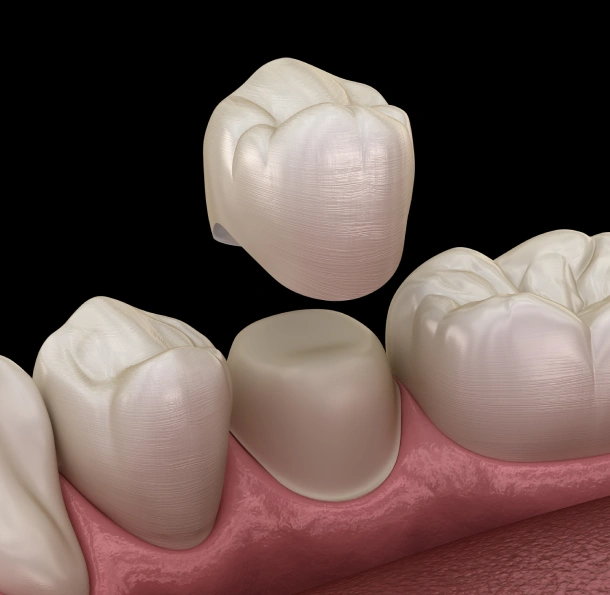
A dental crown, sometimes called a cap, is a custom-made covering that fits over the entire visible surface of a damaged or weakened tooth, from the gumline up. Once cemented in place, the crown restores the tooth's original shape, size, and function while protecting it from further damage.
Crowns are one of the most versatile restorations in dentistry. They're used in a wide range of situations and are designed to be durable and long-lasting, typically 10–15 years or more with proper care.
Common reasons a crown may be needed:
- Large or Deep Cavity When a cavity is too large to be treated with a filling alone, a crown provides the coverage and structural support the remaining tooth needs.
- Cracked or Fractured Tooth A crown holds a cracked tooth together, preventing the crack from deepening and protecting the inner pulp from bacteria and infection.
- Tooth Weakened by Root Canal Teeth that have undergone root canal treatment are more brittle and prone to fracture. A crown placed over the tooth after the procedure protects it and restores full function.
- Broken or Severely Worn Tooth Teeth that are broken down or significantly worn from grinding may not have enough structure left for a filling, a crown rebuilds the tooth completely.
- Existing Crown That Needs Replacement Crowns don't last forever. An old crown that is cracked, loose, worn, or no longer fitting properly needs to be replaced to protect the underlying tooth.
- Anchor for a Dental Bridge Crowns are placed on the teeth on either side of a gap to anchor a dental bridge in place.
What Happens During the Dental Crown Process
Getting a dental crown typically involves two visits. Here's what to expect at each stage:
Visit One — Preparation & Temporary Crown
Examination & X-Ray
We'll thoroughly examine the tooth and take X-rays to assess the extent of damage and confirm that a crown is the right treatment. If there's active decay, it will be removed first.
Tooth Preparation
The tooth is reshaped to make room for the crown. A small amount of enamel is removed from the sides and top of the tooth so the crown fits properly without feeling bulky. The area is fully numbed throughout.
Impressions
We take a precise impression of the prepared tooth and surrounding teeth. This is sent to a dental lab where your custom crown is fabricated to fit your bite exactly.
Temporary Crown
A temporary crown is placed over the prepared tooth to protect it while your permanent crown is being made. Temporary crowns are functional but not as strong as permanent ones — treat them with some care.
Visit Two — Permanent Crown Placement
When your permanent crown is ready, you'll return to have the temporary removed and the permanent crown fitted. We'll check the fit, color, and bite carefully before cementing it permanently in place.
How to Care for Your Dental Crown
A well-maintained crown can last 10–15 years or longer. Here's how to protect your investment:
- Brush twice daily and floss daily — including around the crown and at the gumline
- Be mindful when flossing around a crown — slide the floss out rather than pulling it upward to avoid dislodging it
- Avoid chewing ice, hard candies, or very hard foods that can crack a crown
- If you grind your teeth at night, let us know — a night guard can protect your crown from excessive wear
- Attend regular dental checkups so we can monitor the condition of your crown and the tooth beneath it
- If your crown feels loose, cracked, or your bite feels off, come in promptly — don't wait
We'll assess the condition of your existing fillings and let you know whether replacement is medically recommended or purely elective, so you can make the right decision for your situation.
Walk In Any Weekend for a Crown Consultation
Serving patients across Los Angeles including Westlake, Echo Park, Koreatown, Silver Lake, Downtown LA, and surrounding neighborhoods.
Hours:
Monday - Tuesday: Closed
Wednesday - Thursday: By Appointment Only
Friday - Sunday: 11:00 am – 07:00 pm
Monday - Tuesday: Closed
Wednesday - Thursday: By Appointment Only
Friday - Sunday: 11:00 am – 07:00 pm